Best Self Service Car Wash: The Complete Guide to a Perfect Clean Every Time
Most drivers want a clean car. Far fewer know how to actually get one. Between the paint-scratching rotating brushes of automatic tunnel washes and the unpredictable quality of professional detailing services, there is a middle ground that experienced car care enthusiasts have known about for years — the best self service car wash. A well-chosen self-service bay, used with the right technique and the right products, consistently delivers results that neither the tunnel wash nor the hurried professional shop can match.
This guide is your complete resource for everything connected to the best self service car wash experience. We cover how to find the top-rated facilities near you, what equipment and products to bring, the step-by-step process that ensures a scratch-free and professional-quality result, and the expert techniques that separate an average bay wash from one that leaves your car genuinely gleaming. Whether you are visiting a self-service bay for the first time or looking to sharpen a routine you have been doing for years, every section of this guide has something valuable for you.
What Makes the Best Self Service Car Wash?
Not every self-service car wash bay is created equal. Understanding what separates a top-quality facility from a mediocre one helps you make better choices about where you take your vehicle — and what to do when you get there.
When car enthusiasts and detailing professionals talk about the best self service car wash, they are referring to facilities that combine quality equipment, proper water pressure, a reliable range of wash functions, and a clean, well-maintained environment. These are the non-negotiables that determine whether a self-service facility is genuinely worth your time.
Equipment Quality and Maintenance
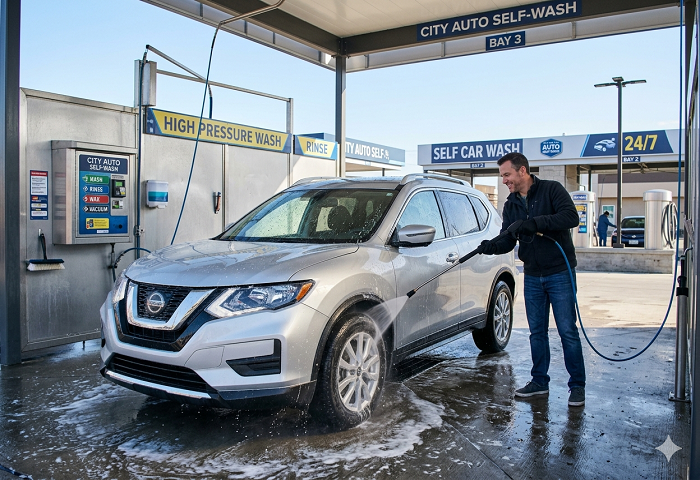
The backbone of any best self service car wash experience is the quality of the high-pressure equipment. A properly maintained pressure wand should deliver consistent pressure between 1000 and 1800 PSI — powerful enough to blast loose road grime and traffic film from the surface but not so aggressive that it risks lifting rubber seals or forcing water into door gaps.
Facilities that maintain their equipment regularly produce noticeably better results. Clogged soap nozzles, inconsistent pressure, and worn trigger guns are all signs of poor maintenance that will compromise your wash. The best self service car wash locations run scheduled maintenance on their equipment and keep their bays clean and functional regardless of how busy they are.
Range of Wash Functions
The finest self-service bays offer a logical sequence of wash functions that mirrors the professional detailing process. Look for facilities that include at minimum: a pre-soak or pre-wash function, a high-pressure soap wash, a high-pressure rinse, and a spot-free or de-ionised final rinse. Many of the best self service car wash locations also offer a foam brush setting, a wheel cleaner function, a clear coat protectant rinse, and a hot wax or polymer rinse.
Each of these functions serves a specific purpose in the wash sequence, and having access to all of them in a single bay is what elevates a standard coin-op into the best self service car wash category.
Water Quality
The final rinse water quality is often the detail that separates a truly outstanding self-service facility from an average one. De-ionised or reverse-osmosis spot-free rinse water leaves virtually no water spots on paint or glass after drying, even if you do not have time for an immediate dry. This feature alone is worth seeking out when evaluating the best self service car wash options near you.
Bay Size and Accessibility
A bay that is too narrow to comfortably move around your vehicle is frustrating and limits what you can achieve. The best self service car wash facilities have generous bay dimensions, good overhead clearance for SUVs and pickup trucks, and well-positioned equipment that does not get in the way of moving around the vehicle freely.
How to Find the Best Self Service Car Wash Near You
Knowing what a great facility looks like is only useful if you can find one. Here is how to locate the best self service car wash options in your area efficiently.
Google Maps Search
Google Maps is the most effective starting point for finding the best self service car wash near you. Search “self-service car wash near me” or “coin-operated car wash near me” and filter results by rating. Sort by highest rating and read the most recent reviews carefully — they will tell you about water pressure quality, equipment reliability, time limit generosity, cleanliness, and whether the spot-free rinse is actually functional.
Look specifically for reviews that mention equipment condition, not just overall satisfaction. A facility that looks clean in photos but has consistently mediocre reviews about pressure and soap quality is not the best self service car wash regardless of its visual appeal.
Dedicated Car Enthusiast Forums and Groups
Online car communities — Reddit’s r/AutoDetailing, local Facebook car groups, and dedicated forums — are excellent resources for finding the best self service car wash in a specific area. Enthusiasts who regularly self-wash their own vehicles have strong opinions about local facilities and will share detailed, experience-based recommendations that Google reviews sometimes lack.
A post asking “what is the best self service car wash near [your city]?” in a local enthusiast group will typically generate a handful of genuinely useful recommendations from people who have put real thought into their evaluation.
What to Look for on Your First Visit
When you visit a new facility for the first time to assess whether it qualifies as your go-to best self service car wash option, run through a quick mental checklist. Is the bay floor clean and free from excessive grime or standing water? Is the pressure wand functioning properly at all settings? Does the soap produce visible foam rather than thin, watery spray? Is the final rinse noticeably different from the standard rinse — clearer, purer water with less mineral content? Are the vacuum stations clean and powerful?
A facility that passes all of these checks qualifies as a genuine candidate for the best self service car wash in your rotation.
What to Bring to the Best Self Service Car Wash
One of the biggest differences between an average self-service bay experience and a genuinely excellent one is what you bring with you. The best self service car wash visit is not just about finding a good facility — it is about arriving prepared to use that facility to its full potential.
Your Own Wash Mitt
The communal foam brushes found in most self-service bays are one of the grimiest items in any car wash environment. They are used by dozens of vehicles per day, accumulate grit and debris from each one, and will absolutely cause scratches and swirl marks in your paint if you use them. Any driver serious about achieving the best self service car wash result brings their own clean microfiber wash mitt and uses the bay’s foam and rinse functions while never touching the communal brush.
A quality microfiber wash mitt with deep pile fibers encapsulates dirt inside the mitt rather than dragging it across the clear coat. It is one of the most impactful tools you can bring to any self-service wash.
Two Buckets and a Grit Guard
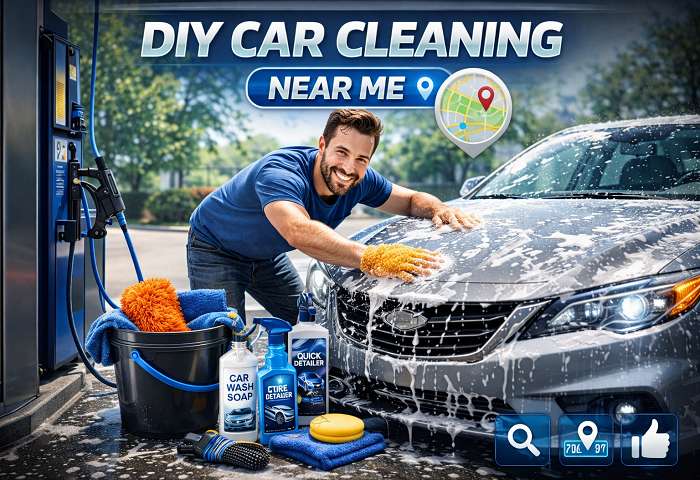
If space allows in your vehicle, bringing two wash buckets fitted with grit guards takes your self-service bay results to another level. One bucket holds diluted car shampoo; the other holds clean rinse water. Using this two-bucket method — loading your mitt from the soapy bucket, washing a panel, then rinsing the mitt in the clean bucket before reloading — is the single most effective technique for preventing wash-induced scratches.
This two-bucket approach is used at every top-tier detailing shop and marks the difference between a wash that adds swirl marks and one that protects the paint it is meant to clean. It is central to achieving the best self service car wash result regardless of facility quality.
Detailing Spray and Drying Towels
Never leave a self-service bay without drying your car. Water allowed to air-dry on paint and glass leaves mineral deposits and water spots that can be stubborn to remove. Bring two large, plush microfiber drying towels — one for the roof, bonnet, and upper panels, one for doors and lower sections — and a bottle of quick detailer spray to use as a lubricant under the towel for a streak-free, protected finish.
Additional Products Worth Bringing
- Wheel cleaning brush and dedicated wheel spray: Bay wheel cleaner functions are useful but rarely match the effectiveness of a quality wheel-specific product agitated with a proper brush.
- Tire dressing applicator and product: The best self service car wash result always includes dressed, finished tire sidewalls — something no bay function provides.
- Clay bar kit (for periodic sessions): Roughly every three to six months, a clay bar treatment after washing removes bonded contamination that even the best pressure wash cannot shift.
- Spray wax or sealant: Applying a protective layer before you leave the bay preserves your work and extends the time before the next full wash is needed.
The Complete Step-by-Step Best Self Service Car Wash Process
Arriving at the best self service car wash facility in your area with all your supplies is only half the equation. The process you follow in the bay determines the quality of your result. Here is the complete sequence, refined from professional detailing practice.
Step 1 — Pre-Rinse the Entire Vehicle
Begin every best self service car wash session with a thorough cold water rinse using the high-pressure setting. Work from the roof downward in a systematic pattern, directing the spray into wheel arches, door sills, front lower bumper, and rear valance where mud and road debris accumulate most heavily. The goal is to remove all loose surface contamination before any product contact is made, so it cannot cause abrasion during the wash stage.
Allow yourself a full 60 to 90 seconds of pre-rinsing. The investment in time here pays dividends in scratch prevention throughout the rest of the wash.
Step 2 — Wheels and Tires First
Always clean wheels and tires before washing the vehicle body. Wheels carry the heaviest contamination — brake dust, iron particles, road tar, and caked-on grime — and cleaning them first prevents that contamination from splashing or dripping onto panels you have already washed.
Apply the bay’s wheel cleaner function or your own dedicated wheel spray to each wheel face, barrel, and spoke area. Allow a 30 to 60 second dwell time. Agitate with your wheel brush, working the face, spokes, and inner barrel as thoroughly as the bay setup allows. Rinse completely with high pressure before moving on to the body.
Apply tire cleaner and scrub with a stiff tire brush before a final rinse of the rubber.
Step 3 — Pre-Soak Application
Switch to the pre-soak or soap function and apply a thorough coat across the entire vehicle, starting at the roof and working down. If the bay offers a dedicated pre-soak setting (typically more alkaline than the standard soap cycle), use it for heavy contamination days. Allow the product to dwell for 60 to 90 seconds to begin breaking down traffic film and road pollution before physical contact.
This contact-free pre-cleaning step is what makes the best self service car wash process genuinely different from a cursory rinse-and-spray routine.
Step 4 — High-Pressure Soap Wash or Hand Wash With Your Mitt
You have two options at this stage, and the right choice depends on your available time and supplies.
Option A — Bay foam brush (least preferred): If you must use the bay’s foam brush, pre-rinse it thoroughly before it touches your paint and use the lightest possible pressure with straight strokes. This is the least desirable option for achieving a best self service car wash result.
Option B — Your own wash mitt with two-bucket method (strongly preferred): Use the bay’s soap function to wet your own mitt, or use your pre-loaded soapy bucket, and hand wash each panel using the two-bucket method described above. This produces the safest and highest-quality result of any best self service car wash approach.
Work from the roof downward, washing one panel at a time with straight, overlapping horizontal strokes. Never scrub in circular motions — they create circular swirl patterns visible in direct sunlight.
Step 5 — High-Pressure Rinse
Switch to the high-pressure rinse function and flush all soap from the vehicle completely. Work from the roof down, directing water into every gap, badge edge, mirror surround, grille channel, and door handle recess. Soap left to dry on paint creates dull, hazy residue that is frustrating to remove after the fact.
Step 6 — Spot-Free Final Rinse
If the bay offers a spot-free or de-ionised rinse function, always use it as your final step before drying. This pure water rinse removes the mineral content that causes water spots during drying. At the best self service car wash facilities, the spot-free rinse makes an immediately visible difference — the water sheeting off treated paint looks noticeably cleaner and clearer than standard rinse water.
Step 7 — Dry Immediately
Move your vehicle out of the bay as promptly as possible after rinsing and dry it immediately using your plush microfiber towels. Apply quick detailer spray to each panel before running the towel across it for lubrication and additional protection. Work from the roof down, using gentle pressure and straight strokes.
Step 8 — Apply Protection
Once the vehicle is dry, apply your spray wax, paint sealant, or quick detailer to all painted surfaces for a finishing layer of protection. This step is what makes the results of the best self service car wash session last significantly longer than an unprotected wash.
Dress the tire sidewalls with tire dressing applied via a foam applicator for a clean, finished appearance. Wipe down any door jambs or shut faces that may have been missed during the bay wash.
Tips From Detailing Pros for the Best Self Service Car Wash Results
Beyond the step-by-step process, experienced detailers and self-service car wash veterans have developed a collection of best practices that consistently improve results.
Wash in the early morning or late afternoon. Direct midday sunlight heats the paint and causes soap to dry before you can rinse it, leaving residue marks and water spots. Cooler light conditions make every step of the best self service car wash process easier and safer for the paint.
Never use the communal foam brush on your paint. This point bears repeating because it is the single most common source of self-service bay-induced scratches. Bring your own mitt every time without exception.
Work quickly but methodically. Coin-operated bays charge by the minute, which creates pressure to rush. Beat this by having a clear mental map of your sequence before you start spending. Know exactly which function you are using at each stage and in what order, so every second counts.
Use the pre-soak function twice on heavily contaminated vehicles. For a car that has not been washed in several weeks or has accumulated heavy road grime, a double pre-soak application before any contact washing dramatically reduces the abrasion risk during the mitt stage.
Top up your protection every wash. Applying a spray wax or detailer after drying at the end of every best self service car wash visit builds up a cumulative protective layer that makes each subsequent wash faster, easier, and safer for the paint surface.
How Often Should You Visit the Best Self Service Car Wash?
Frequency depends on your environment, driving habits, and personal standards. Here is a practical maintenance schedule built around the best self service car wash routine.
Every 2 to 3 weeks — Maintenance wash: Full bay wash using your mitt and two-bucket method. Spray wax during drying. This cadence keeps contamination from bonding to the paint and maintains a consistent protective layer.
Every 3 months — Decontamination wash: Full bay wash followed by clay bar treatment to remove bonded contamination before a fresh application of wax or sealant. This is the best self service car wash session to schedule before seasonal changes.
Every 6 months — Full exterior detail: In addition to your regular bay wash, perform paint correction at home for any accumulated swirl marks, followed by a fresh coat of synthetic sealant or ceramic coating spray.
Vehicles parked outdoors, driven near the coast, or operating in high-pollution urban environments will benefit from the shorter end of each interval. A garaged daily driver in a low-contamination area can typically extend to the longer end.
Common Mistakes People Make at Self Service Car Washes
Even experienced drivers make avoidable mistakes at self-service bays that undermine an otherwise good result. Here are the most important errors to eliminate from your best self service car wash routine.
Using circular scrubbing motions: Always wash in straight, overlapping strokes. Circular motions create circular swirl marks that are immediately visible in sunlight.
Skipping the pre-soak dwell time: Applying soap and immediately making contact contact washes before the product has had time to work. Give every pre-soak and soap application at least 60 seconds of dwell time.
Washing in direct sunlight: Heat is the enemy of a clean finish. Schedule your best self service car wash visits for cooler parts of the day.
Using the communal brush on painted surfaces: Already covered above, but worth repeating one final time — the communal foam brush is not worth the scratch risk. Your own wash mitt is non-negotiable.
Leaving without drying: Air-drying creates water spots. Always dry immediately after rinsing, even if it means pulling out of the bay first.
Skipping protection: A wash without any protective product at the end leaves the paint exposed. Even a 30-second spray wax application during drying provides meaningful defence.
Final Thoughts
The best self service car wash experience is about far more than finding the closest coin-operated bay and running through it quickly. It is about choosing the right facility, arriving prepared with the right tools, following the right process, and applying the professional techniques that ensure a scratch-free, genuinely clean result every single time.
Invest in a good wash mitt, commit to the two-bucket method, always use the spot-free rinse, and never skip protection. Do those four things consistently at the best self service car wash in your area, and your car will look better than 95% of the vehicles on the road — maintained by your own hands, at a fraction of the cost of professional services, and with results that actually last.
The best car wash you can get is almost always the one you do yourself.